




Rwanda Fears the Dismantling of the FDLR Could Force the Withdrawal of RDF Troops from the DRC
A disputed protocol on the disarmament, demobilization and cantonment of FDLR fighters has intensified tensions between Kigali and Kinshasa over the Washington Agreement and the withdrawal of Rwandan forces from eastern DRC.
Available in
Tensions continue to escalate between the Government of Rwanda and the Democratic Republic of the Congo (DRC) following the signing of what Kinshasa described as a "protocol" by the FDLR concerning disarmament, demobilization, and the cantonment of its fighters. The DRC maintains that this process forms part of the implementation of the Washington Agreement and its accompanying CONOPS.
Rwanda's Minister of Foreign Affairs, Olivier J.P. Nduhungirehe, immediately condemned the move, arguing that the signing of the so-called "protocol" between the Congolese Government and the FDLR has no basis whatsoever in the Washington Agreement, as the agreement makes no provision for such a protocol. He added that the reason is simple: “The FDLR, which is a genocidal group, is not a party to the agreement but rather the subject of its provisions.”
Nduhungirehe stated that the initiative is an obvious attempt by Kinshasa and its allies to mislead public opinion through delaying tactics aimed at evading their primary security obligations. He explained that, under the CONOPS and OPORD, those obligations were supposed to have been fulfilled within 90 days.
He continues accusing the Congolese authorities that since the signing of the Washington Agreement on December 4, 2025, the Government of Kinshasa has not reduced the military support it provides to the FDLR. Nduhungirehe accused the Congolese Government of integrating a significant number of FDLR members into the Congolese armed forces. He also claimed that Kinshasa has accelerated efforts to reorganize the group politically with the support of several politicians living in Europe who are associated with the former government of Juvenal Habyarimana, including Jean-Luc Habyarimana, Fabien Singaye, Thomas Nahimana, and Thadée Kwitonda.
On the Congolese side, Minister of Communication Patrick Muyaya announced that, in accordance with the Washington Agreement and the CONOPS, the FDLR had signed a "protocol" on disarmament, demobilization, and cantonment through a sensitization campaign. He described the development as a major turning point in addressing an issue that, according to him, Rwanda has used for the past 30 years as justification for maintaining its military presence in eastern DRC in support of the AFC/M23 rebels.
Muyaya also stated that he and the Minister responsible for Regional Integration, Floribert Anzu, would later provide a more detailed explanation of this development, which had become one of the central issues discussed during their recent diplomatic tour in Europe and Africa.
Journalist and political analyst Samuel Baker Byansi argued that Kigali needs the FDLR to remain in existence. He commented: “If the group were completely dismantled, President Paul Kagame's government would lose what he described as the principal justification it has relied upon for the past three decades to continue deploying Rwandan troops on Congolese territory.”
Byansi stated that Kagame does not want the issue to be resolved because he still needs the benefits he derives from the DRC. He also referred to remarks made by Rwanda's Government Spokesperson, Yolande Makolo, who maintains that the FDLR has infiltrated the Congolese armed forces and is fighting on the front lines, while demanding that the group's dismantling be carried out in a visible and verifiable manner. According to Byansi, such a demand effectively amounts to asking the DRC to dismantle its own army, making it an impossible condition to fulfill.
What appears significant is that neither Makolo nor Patrick Muyaya addressed one crucial point: they did not acknowledge that it is Rwandan troops that are present on Congolese territory, not Congolese troops operating inside Rwanda. This, according to the argument presented, means that the party accused of initiating the conflict is demanding that the country it attacked first disarm.
It is evident that the Rwandan Government continues to portray itself as a victim while paying little attention to the obligations imposed by the various agreements it has signed concerning this conflict. This explains why Government Spokesperson Yolande Makolo argued that the Washington Agreement requires the complete neutralization of the FDLR rather than the signing of a "protocol" with a group accused of participating in the genocide, which she says the Congolese Government continues to arm and cooperate with.
Makolo further argued that publicizing voluntary disarmament efforts changes nothing as long as the FDLR remains integrated into the Congolese armed forces and continues fighting on the front lines. She maintained that implementing the agreement requires the verifiable dismantling of the FDLR rather than symbolic actions intended for public display.
Although Rwanda continues to present the FDLR as a major threat to its national security, several reports, including those issued by the United Nations, indicate that Rwanda itself acknowledges that the group no longer represents a significant danger, claiming that it has already been weakened by nearly 99 percent.
Furthermore, Rwanda has conducted several military operations over the years, leading many experts to conclude that the original FDLR has already been largely neutralized through joint military operations conducted by Rwandan and Congolese forces, including "Umoja Wetu." It is also well documented that many members of the group, including some of its leaders, have been repatriated to Rwanda.
In this context, the Rwanda Demobilization and Reintegration Commission (RDRC) announced on Wednesday, July 29, that it had handed over 39 Congolese nationals to the authorities of the Democratic Republic of the Congo (DRC), claiming that they had falsely presented themselves as former FDLR combatants when they were not. According to an investigation conducted by BADRAMATV, however, Rwanda's claim that the group had been handed over to MONUSCO for transfer to the DRC authorities is false. Instead, MONUSCO reportedly stated that the individuals should first be returned to the place from which they had been taken.
Since major powers and international organizations intensified diplomatic efforts to resolve the conflict, Rwanda has consistently sought justifications for preventing the war from coming to an end. At the same time, given the strategic interests of the United States in the Democratic Republic of the Congo, Rwanda could face serious consequences if it continues to resist withdrawing its troops as required under the agreements it has signed.
Rwanda and its allies are reportedly doing everything possible to obstruct or undermine the implementation of the Washington Agreement with the objective of triggering a broader war against President Félix Tshisekedi. This is also reflected, according to the argument presented, in the continued efforts by the AFC/M23 rebels to acquire heavy weapons, recruit additional fighters, and provide them with military training, despite commitments made under the various agreements they have signed.
Related coverage
More from Congo
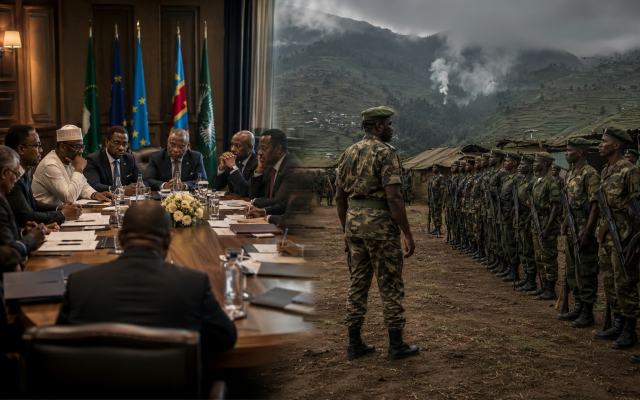
DRC: Peace Talks Continue, but AFC/M23 Keeps Intensifying Military Preparations
As peace negotiations on eastern DRC continue, AFC/M23 says it has trained 9,318 new commandos, raising concer...
 Breaking
 Breaking
Loading comments…
Reader comments
Join the conversation