




Trump Sends Nicholas Checker to Kigali: Can He Navigate Rwanda's Political Minefield?
"Selecting Nicholas Checker as U.S. ambassador to Kigali was no accident. Washington intentionally chose a career intelligence officer at a time when sending a conventional diplomat would have been considered sufficient."
Available in
The relationship between the United States and Rwanda has become increasingly strained since Washington took a more direct role in efforts to address the conflict between Rwanda and the Democratic Republic of Congo (DRC), although much of the diplomatic friction has remained behind closed doors.
U.S. President Donald Trump has adopted rhetoric on Rwanda that departed from previous American positions. He publicly argued that the conflict in eastern DRC is not merely an internal Congolese war but a conflict involving both Rwanda and the DRC. Trump also vowed to bring the war to an end and said those responsible for the deaths of an estimated six million people over the course of the conflict should be held accountable. Rwandan authorities have consistently rejected that characterization, maintaining that the conflict is an internal Congolese matter.
Negotiations leading to the Washington Agreement were repeatedly delayed as several signing dates were announced and later postponed, with many observers attributing the delays to Rwanda's apparent reluctance to move forward. The agreement was eventually signed on December 4, 2024.
Following the signing, relations between Kigali and Washington appeared to deteriorate further. Rwanda increasingly criticized the United States, accusing it of siding with the DRC. Those tensions remain evident today. Just days ago, President Paul Kagame claimed that Washington had lured Rwanda into the agreement in pursuit of its own strategic interests, reinforcing the perception that the two countries are now engaged in what resembles a diplomatic cold war.
Against that backdrop, President Trump's decision on July 21 to nominate Nicholas Checker as the next U.S. ambassador to Rwanda attracted considerable attention. For many observers, the appointment was anything but routine.
Political analyst and journalist Samuel Byansi argues that the choice was deliberate.
"Selecting Nicholas Checker as U.S. ambassador to Kigali was no accident. Washington intentionally chose a career intelligence officer at a time when sending a conventional diplomat would have been considered sufficient."
Regional political analysts largely share that assessment, pointing to what they describe as Rwanda's increasingly assertive posture in regional affairs. According to many observers, Kigali has sought to position itself as an untouchable regional power, expecting not only neighboring countries but also international partners that once supported its rise to accommodate its political objectives.
Checker arrives in Kigali with a Master's degree in Security Studies from Georgetown University and more than a decade of experience in U.S. intelligence. From 2014 to 2025, he served at the Central Intelligence Agency (CIA), specializing in conflicts across the Greater Middle East and the Horn of Africa.
He also worked in the CIA's Office of Congressional Affairs, where he coordinated intelligence matters with the U.S. Congress.
Among his most notable assignments was his work on Afghanistan, which earned him two prestigious intelligence honors: the Intelligence Commendation Medal in 2021 and the Director's Award for Analysis in 2022.
In 2023, Checker became a National Security Fellow serving Republican Senator Bill Hagerty. By late 2025, he had joined the National Security Council as Deputy Executive Secretary, overseeing high-level reviews of critical national security and defense documents.
His performance led to his appointment in early 2026 as Deputy Assistant Secretary responsible for Southern Africa and foreign assistance before assuming leadership of the Bureau of African Affairs as its Senior Bureau Official on January 6.
According to this analysis, Washington's decision to send Checker to Kigali reflects a broader strategic calculation. His appointment comes at a time when the United States is closely monitoring Rwanda's approach to the conflict in eastern DRC and the implementation of the Washington Agreement signed on December 4, 2024. His background in intelligence, rather than traditional diplomacy, is viewed by many as carrying significant strategic meaning.
Unlike most career diplomats, Checker has been trained to identify influence operations, deception, disinformation campaigns and covert manipulation. Supporters of his appointment argue that these skills could prove particularly valuable in dealing with a government that critics accuse of relying on sophisticated political messaging, intimidation and strategic communication to advance its interests.
One politician interviewed for this article argued that Kigali's own actions have gradually created the circumstances that now confront it.
"The trap I am talking about is someone like Checker," he said, adding that other countries are increasingly adopting the same approach as the United States.
According to this view, while Rwandan officials have often projected confidence in their political and diplomatic strategy, they now face an ambassador whose expertise includes analyzing human intelligence, satellite imagery and classified intelligence reporting. He is also expected to oversee Washington's strategic interests in the Great Lakes region, particularly regarding critical minerals.
For President Paul Kagame, the era in which Rwanda could shape international narratives, challenge international institutions and rely on sophisticated information campaigns may be approaching its limits.
The central question now is why President Trump chose a figure like Nicholas Checker at this particular moment.
One interpretation is that, after Kagame repeatedly signaled his willingness to challenge Washington publicly, the United States has decided to respond with a representative whose intelligence background reflects a more assertive American approach toward Kigali.
At the same time, diplomatic precedent suggests that uncertainty remains. Rwanda has previously rejected ambassadorial nominees from other countries, just as some of its own ambassadorial appointments—including figures such as Karamba and Dani Munyuza—were refused accreditation by countries where they had been assigned.
Whether Kigali ultimately accepts Nicholas Checker as the next U.S. ambassador remains an open question, one that could become another significant test in the increasingly complex relationship between Washington and Kigali
Related coverage
More from Rwanda
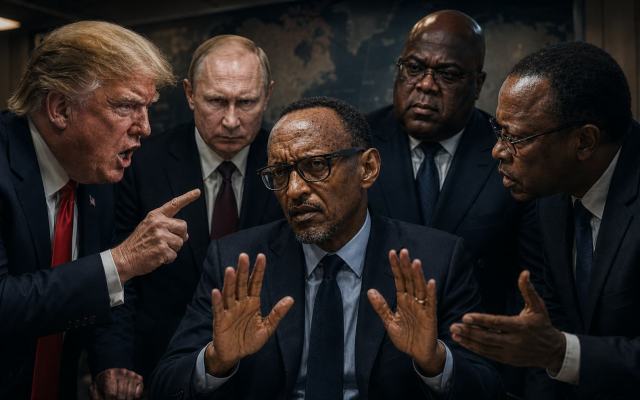
Kagame Says Only Death Can Silence Him Amid Growing Pressure Over DR Congo Conflict
President Paul Kagame said countries seeking to silence him would only succeed if he were dead, as Rwanda face...
Rwanda Eyes France's 2027 Election as Candidates Raise Questions Over Future Ties
Rwanda is closely monitoring France’s 2027 presidential election amid concerns that a change of leadership in...
 Breaking
Loading comments…
Reader comments
Join the conversation