






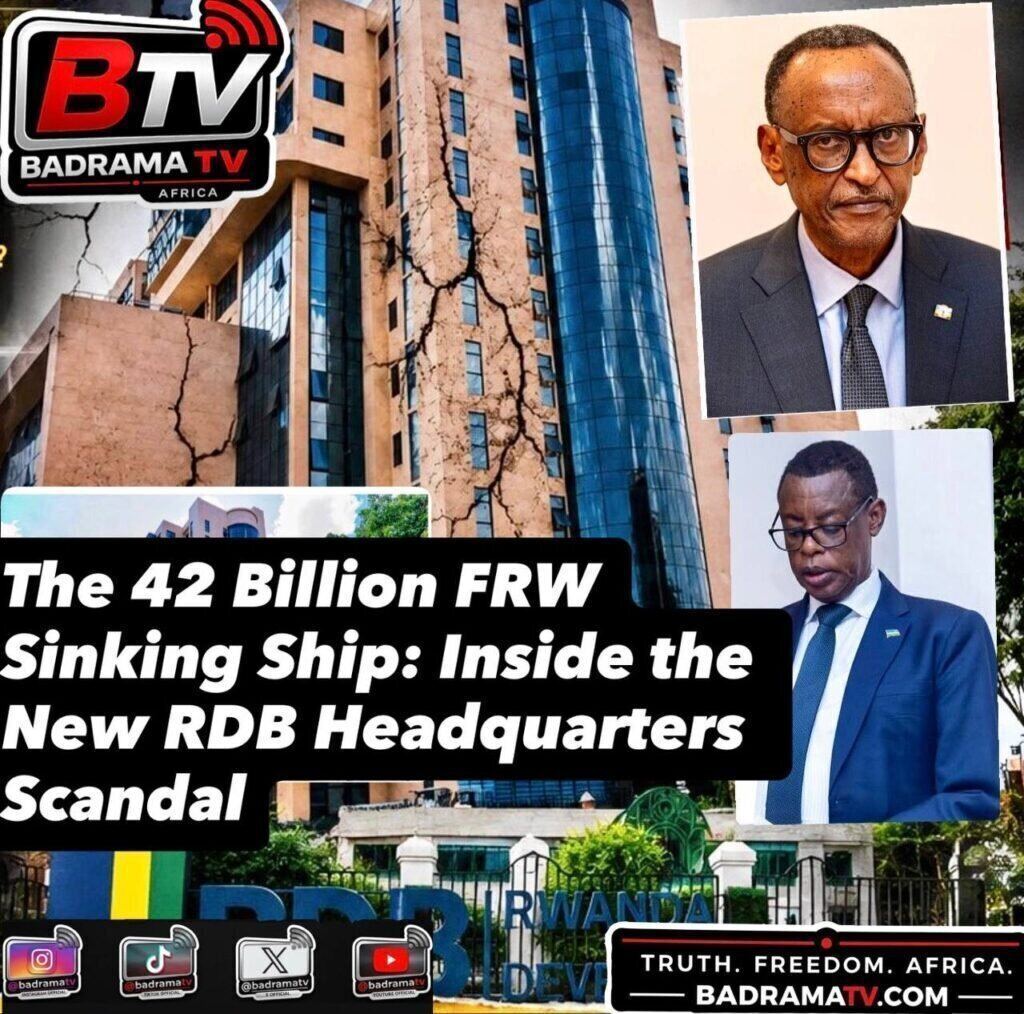
The 42 Billion FRW Sinking Ship: Inside the New RDB Headquarters Scandal
 alt="" width="1024">
The story of the new Rwanda Development Board (RDB) headquarters is not just about a building. It is a stark case study in how systemic corruption and inner-circle political interests can compromise national safety while wasting billions in taxpayer money.
Located directly adjacent to Parliament in Kimihurura, this structure was meant to be a symbol of national progress. Instead, it has transformed into a shared public tragedy. The situation highlights a massive gap between Rwanda’s shiny global branding and its internal governance realities.
A Building Too Heavy for Its Foundation
At the heart of this crisis is a fundamental structural flaw. The building, originally constructed by Albert Housing Supply, was reportedly designed to serve only as a warehouse.
When the project suddenly shifted to a multi-story office complex, its core purpose changed. It was designated to house four of the country’s most critical institutions:
- The Rwanda Development Board (RDB)
- The Rwanda Convention Bureau (RCB)
- The Rwanda Mining Board (RMB)
- The Rwanda Housing Authority (RHA)
Crucially, the structural integrity of the building was never upgraded to meet the heavy demands of a multi-story office complex.
The building began to show signs of structural failure, including sinking and cracking, almost immediately. Reports indicate that a Turkish housing company was brought in to conduct an independent assessment before state agencies moved in.
The engineers’ report was chilling: the building was structurally unsound. Despite this explicit expert warning, the government proceeded with the purchase.
The Economics of Greed: 42 Billion vs. 29 Billion
The financial details of the acquisition raise immediate red flags. Independent experts valued the unfinished building at approximately 29 billion FRW.
Despite this valuation, the government purchased the property for a staggering 42 billion FRW in late 2023.
This 13-billion-franc markup represents far more than a simple overpayment. Evidence suggests it functioned as a deliberate, state-funded bailout for private interests.
The “Top Secret” Connection: Who Profited?
The building is widely linked to a high-ranking general, who is alleged to be the financial power behind Albert Housing Supply.
When it became clear that the project was a structural and financial disaster, the ruling elite reportedly orchestrated a government intervention.
By forcing the state to buy the building at an inflated price, the private financial losses of powerful individuals were effectively transferred onto the backs of Rwandan taxpayers.
The Irony of the Residents
The most biting irony of this scandal involves the identity of its tenants. The Rwanda Housing Authority (RHA), the very agency responsible for setting national building standards and ensuring public safety, was housed inside the flawed structure.
If the national regulator of housing cannot or will not identify a sinking ship for its own office, ordinary Rwandan citizens are left with little hope for safety and transparency.
A Pattern of Displacement and Loss
This specific site also carries a legacy of historical injustice and land displacement. The plot is the exact land where another former general attempted to build in 1998 before he was stripped of the property.
The site is also tied to the narrative of a prominent late local businessman, whose properties and legacy have been systematically absorbed or rebranded by the state.
This recurring pattern suggests that prime real estate in Kigali operates as a revolving door for the ruling inner circle. In this system, original owners are routinely pushed out to make way for elite private investments.
Global Image vs. Local Reality
The structural failure stands in sharp contrast to Rwanda’s international marketing. RDB is famous globally for its multi-million-dollar promotional partnerships with elite football clubs like Arsenal, PSG, and Bayern Munich.
Yet, while the world sees Rwanda as a sleek, efficient investment hub, the local reality is chaotic. RDB employees were forced to flee their own headquarters within months of moving in because the building was on the verge of collapse.
This story serves as a critical wake-up call for the youth of Rwanda. It demonstrates that meaningful societal change requires demanding deep institutional accountability.
When billions in public taxes are used to buy a warehouse masquerading as an office complex solely to protect a powerful official from a bad investment, the entire nation loses. This entire tragedy isn’t just about a crack in a physical wall; it is about a profound crack in the system.
Related coverage
More from Investigations
DRC's Critical Minerals: The Plunder Must End, and Its Sovereignty Must Be Respected
This report examines how the illicit exploitation and trafficking of critical minerals continue to fuel confli...

RPF-Inkotanyi Moves to Offload Business Empire Amid Mounting Fears of More U.S. Sanctions
The ruling RPF-Inkotanyi is reportedly restructuring business interests held through Crystal Ventures Limited...

Loading comments…
Reader comments
Join the conversation