





How the Liberation Legacy Became the Strongest Defense of Rwanda’s Ruling Circle.
The Contradiction at the Heart of Modern Rwanda.
Few governments in Africa draw their political legitimacy from a story as powerful as Rwanda's. The Rwandan Patriotic Front (RPF) is remembered as the force that stopped the 1994 Genocide against the Tutsi, defeated the genocidal government, and helped pull a devastated country back from the edge of collapse. That achievement is not disputed. It remains one of the defining moments in Rwanda's modern history.
Over the past three decades, Rwanda has rebuilt itself in ways that many people thought were impossible in 1994. Roads were built, institutions were restored, cities expanded, and security returned to a country that had been torn apart by war and genocide. For many Rwandans, these achievements are closely linked to the movement that took power after the genocide and continues to govern the country today.
Yet alongside that success story runs another conversation, one that has never completely disappeared no matter how much time passes. It is a conversation about accountability, about accusations documented by human rights organizations and UN investigators, and about whether some chapters of Rwanda's post-genocide history remain too sensitive to discuss openly.
That is where one of modern Rwanda's biggest contradictions begins. The same liberation story that gave the ruling establishment enormous legitimacy has also become one of its strongest political protections. In today's Rwanda, questioning those in power is often interpreted as questioning the country's recovery, its stability, or even the liberation itself. As a result, discussions that would normally focus on evidence, accountability, or governance quickly become discussions about loyalty, patriotism, and national unity.
Understanding Rwanda today therefore requires looking beyond the events of 1994. It requires examining how the memory of liberation continues to shape political life, determine who is considered credible, and influence which questions can be asked without consequences.
"We Stopped the Genocide," , And the Questions Stopped Too
The liberation narrative occupies a special place in Rwanda's political life because it is rooted in historical truth. The RPF stopped the genocide when the international community failed to act. That reality gives the movement a moral authority few governments anywhere in the world possess.
The challenge is that, over time, historical legitimacy can evolve into political immunity.
For many years, discussions about governance, accountability, or the conduct of powerful institutions have often collided with the liberation narrative. Once that happens, criticism is no longer treated as criticism. It becomes something larger and more controversial. A question about state power can be portrayed as an attack on national unity. A question about accountability can be portrayed as an attempt to rewrite history. A question about the conduct of senior officials can be framed as an attack on those who saved the country.
This pattern has appeared repeatedly in Rwanda's political life. Opposition politicians, journalists, former military officers, activists, and government critics have frequently found themselves facing accusations that go far beyond ordinary political disagreement. Some have been accused of divisionism, others of undermining national unity, and others of serving hostile interests. Whether these accusations are justified or not is often less important than what follows: the public conversation shifts away from the original issue and toward the character, loyalty, or intentions of the person raising the question.
The result is that some subjects become extraordinarily difficult to discuss. Not because they have been resolved, but because challenging the accepted narrative carries political and social risks. In such an environment, history becomes more than a record of the past. It becomes a source of political authority, a shield against scrutiny, and sometimes a weapon against dissent.
The Accusations Buried but Never Forgotten
For more than thirty years, reports from Human Rights Watch, Amnesty International, United Nations investigators, legal scholars, and independent researchers have documented serious accusations involving RPF military operations during and after the genocide, as well as Rwanda's role in conflicts that later engulfed the Democratic Republic of Congo.
These accusations did not emerge from a single report or a single organization. They appeared repeatedly across different investigations, different countries, and different periods. Some focused on civilian killings and reprisals during the months following the genocide. Others examined military operations carried out during the Congo wars, where investigators documented accusations involving attacks on refugee populations, civilian casualties, and broader questions of accountability.
The publication of the UN Mapping Report brought renewed attention to many of these issues. Although interpretations of the report remain fiercely contested, its findings ensured that questions surrounding Rwanda's regional military activities would not simply disappear from international discussion.
What is striking is not only the seriousness of the accusations but their persistence. More than three decades after 1994, many of the same questions remain unanswered. They continue to surface whenever new reports are published, whenever tensions rise in eastern Congo, or whenever international organizations revisit the history of the Great Lakes region.
Rwanda's government has consistently rejected many of these accusations and argues that they ignore the security threats the country has faced since the genocide, including armed groups operating across the border that include elements linked to the perpetrators of 1994. That argument continues to resonate with many Rwandans.
At the same time, the accusations have never fully disappeared. They remain part of the historical record, part of international debate, and part of an uncomfortable conversation that Rwanda has never completely escaped.
Related coverage
More from Rwanda
Rwanda: Oaths of Loyalty Under Scrutiny as Critics Warn of Political Intimidation
A debate over political loyalty oaths in Rwanda is raising questions about freedom of association, the right t...
BADRAMA: “They Say I Must Be Killed Because I Crossed a Red Line”
BADRAMA says his human-rights advocacy and political commentary have placed his life in danger, alleging repea...
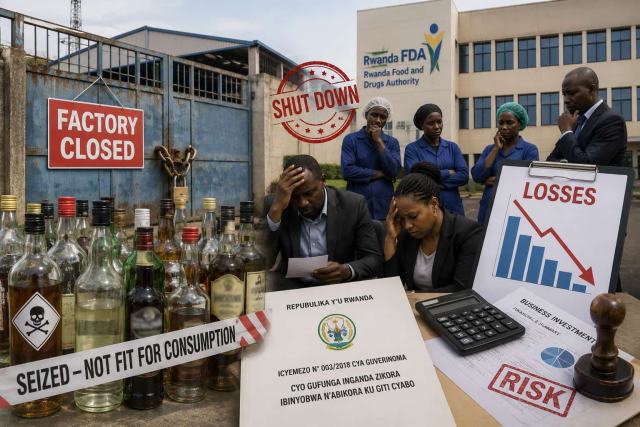
Disorderly Governance within the FPR Inkotanyi Administration as a Major Cause of Losses for Many Investors
The closure of several alcoholic beverage manufacturers has renewed debate over Rwanda FDA’s oversight, coordi...
Loading comments…
Reader comments
Join the conversation