By Sheila Kamuzinzi,
Published on badramatv.com
As diplomatic activity between Kigali and Washington intensifies, Rwanda’s government supporters have increasingly presented each new engagement with the United States as evidence that international pressure on Kigali is fading.
Official meetings, bilateral agreements, and visits by American officials are often celebrated in pro-government circles as signs that Washington now firmly backs Rwanda’s position in the regional crisis surrounding eastern Democratic Republic of the Congo (DRC).
But analysts say the broader geopolitical picture is considerably more complex.
While the United States continues to engage Rwanda diplomatically and economically, Washington has simultaneously deepened strategic cooperation with the DRC and maintained pressure regarding instability in eastern Congo.
The contrast between these two realities has become central to the political messaging surrounding the conflict.
Diplomatic Engagement as Domestic Political Messaging
In recent months, Rwandan state-aligned commentators and online supporters have frequently highlighted meetings between President Paul Kagame and U.S. officials as signs of growing American confidence in Kigali.
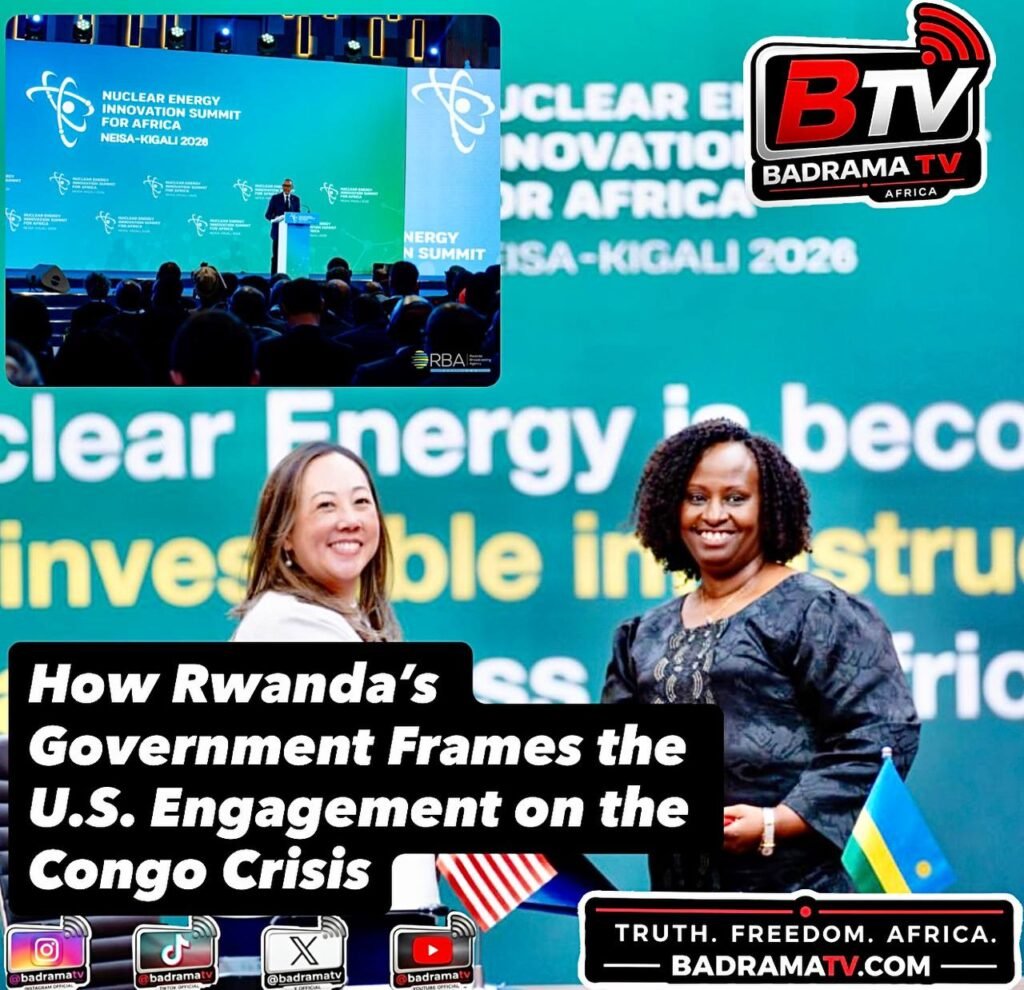
The same narrative has accompanied new cooperation agreements, including the recently announced civil nuclear cooperation memorandum between the United States and Rwanda.
Supporters of the government have described such agreements as evidence that Rwanda remains a trusted strategic partner despite international criticism linked to the conflict in eastern Congo.
Political observers, however, note that diplomatic engagement does not necessarily indicate unconditional political alignment.
“Major powers often maintain relationships with governments for strategic and economic reasons, even when disagreements exist on security or regional issues,” one regional analyst said.
According to analysts, Rwanda’s leadership has sought to present continued Western engagement as proof that Kigali has successfully resisted diplomatic isolation over the Congo crisis.
What the Washington Peace Framework Actually Focused On
The Washington-mediated peace framework involving Rwanda and the DRC was widely portrayed by pro-government voices as a diplomatic success for Kigali.
However, the framework itself placed significant emphasis on:
- respect for Congolese territorial sovereignty,
- de-escalation in eastern Congo,
- disengagement mechanisms,
- and concerns surrounding armed groups operating in the region.
For many observers, those provisions reflected continuing international concern about the conflict rather than a shift in Washington’s position toward unconditional support for Rwanda.
Critics of the government argue that domestic coverage in Rwanda focused more heavily on the symbolism of high-level diplomacy, including official ceremonies and photographs, than on the substance of the agreement itself.
“The optics were politically useful,” a Kigali-based political observer said. “But the actual framework still centered on stabilizing eastern Congo and addressing regional security concerns.”
The Nuclear Cooperation Agreement and Its Political Interpretation
The recent civil nuclear cooperation memorandum between the United States and Rwanda has become another focal point in Rwanda’s political messaging.
Government supporters described the agreement as evidence of strong American confidence in Rwanda’s leadership and long-term stability.
The memorandum primarily concerns:
- civilian energy cooperation,
- infrastructure development,
- technical collaboration,
- and long-term investment opportunities.
Regional analysts caution, however, against interpreting the agreement as a broader geopolitical endorsement of Rwanda’s policies in eastern Congo.
Economic and technological cooperation between states often exists alongside diplomatic disagreements in other areas, particularly in regions where strategic interests overlap.
“The United States can simultaneously pursue investment partnerships with Rwanda while maintaining pressure related to security issues in eastern DRC,” one regional researcher noted.
Why Congo Remains Strategically Important to Washington
At the center of Washington’s regional calculations is the growing strategic importance of the Democratic Republic of the Congo.
The DRC possesses some of the world’s largest reserves of critical minerals used in:
- electric vehicle batteries,
- advanced technologies,
- defense industries,
- and global manufacturing supply chains.
As competition with China intensifies, U.S. interest in securing access to critical mineral supply chains has expanded significantly.
This has increased Congo’s geopolitical importance in American foreign policy discussions concerning Africa.
Analysts say this broader strategic reality complicates claims that Washington has decisively shifted toward Rwanda.
“The United States sees both Rwanda and Congo as important,” one Central Africa specialist explained. “But Congo’s economic and strategic weight gives it a very different level of significance in long-term regional planning.”
That dynamic helps explain why U.S. officials continue emphasizing:
- stabilization of eastern Congo,
- regional security cooperation,
- and respect for Congolese sovereignty.
Diplomacy Does Not Always Equal Political Support
One of the central debates surrounding the current political narrative is whether diplomatic engagement should be interpreted as political endorsement.
International relations experts caution against drawing overly simplistic conclusions from official meetings and bilateral agreements.
The United States routinely engages governments around the world for reasons that include:
- regional stability,
- economic interests,
- security cooperation,
- intelligence partnerships,
- and geopolitical balancing.
As a result, continued engagement between Washington and Kigali does not necessarily mean the United States fully supports Rwanda’s position in the Congo conflict.
At the same time, analysts note that Rwanda’s domestic political messaging increasingly portrays such engagements as signs of international validation.
A Battle Over Perception
For Rwanda’s government, projecting an image of international legitimacy and diplomatic strength remains politically important.
Analysts say that image becomes especially significant during periods of heightened international scrutiny.
As a result, symbolic moments, including diplomatic visits, investment announcements, and high-profile agreements , often take on broader political meaning inside Rwanda.
Critics argue that this emphasis on optics can overshadow unresolved questions surrounding the conflict in eastern Congo and Rwanda’s role in regional tensions.
Supporters of the government, meanwhile, maintain that Rwanda continues to be unfairly targeted internationally despite its security concerns along the Congolese border.
The debate reflects a broader struggle not only over regional policy but also over public perception.
What remains clear is that while diplomatic engagement between Rwanda and the United States continues, Washington’s long-term strategic interests in Central Africa extend far beyond symbolic political gestures.
The MoU on nuclear energy is not worth the papers it’s written on coz the U.S will not fund it and the FPAUL government doesn’t have the funds either